
Get a free on-site commercial assessment
Solar and batteries for Northern Rivers businesses, up to 1 MW. Commercial finance through Solaris Finance.
Sun Connect Solar designs and installs off-grid solar and battery systems for Northern Rivers hinterland properties, inspects existing ones, and maintains and repairs the ones we install, using our own in-house electricians. Our installation work carries a 25-year workmanship warranty.
Short answer: yes. Sun Connect Solar designs and installs off-grid solar and battery systems across the Northern Rivers hinterland, inspects existing ones, and maintains and repairs the ones we install, with our own SAA-accredited electricians.
Off-grid systems for hinterland properties, plus inspections, and the maintenance and repairs that keep the systems we install running.
The hills behind Byron, Mullumbimby, Murwillumbah and Lismore have plenty of properties where the grid is a long way off or was never connected: places like Main Arm, Wilsons Creek, Federal, Goonengerry, Clunes and Uki. Off-grid power there has to work through a wet week in winter, not just a sunny day in spring.
Get a free energy assessment · Call 0483 903 020
★★★★★ Rated 5.0 from 65 Google reviews · read them on Google · read them on our reviews page
We design and install off-grid solar and battery systems on rural and hinterland properties across the Northern Rivers, on the NSW side of the border only:
Hinterland jobs by our own team: a Mullumbimby hinterland home taken fully off-grid (13.3 kW of solar, a 16 kWh Sigenergy battery and an auto-start generator), and, staying on the grid with a big battery, 30.5 kW of AIKO solar and a 54 kWh Sigenergy battery in its own shed and 22.8 kW of solar and a 40 kWh Sigenergy battery at Huonbrook.
Most of these are properties where the grid is a long way off, where a new grid connection would be costly, or where the owners want to be independent of the grid. If you are near the grid and mainly want power in a blackout, compare blackout backup batteries.
An off-grid system has no grid to fall back on, so we design for the hard times:
Off-grid systems are designed to the Australian standards for stand-alone power systems, and the battery location rules still apply.
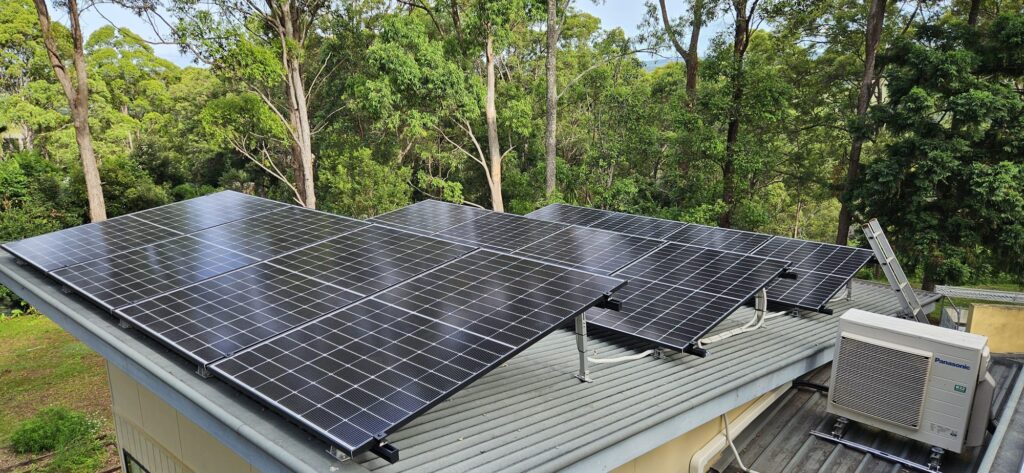
Recent off-grid job: a Mullumbimby hinterland home taken fully off the grid with 13.3 kW of solar on tilt frames, a 16 kWh Sigenergy battery and an auto-start diesel generator.
Many hinterland systems were put in years ago and have grown piece by piece. Common upgrades:
Off-grid systems work hard every day. We suggest a yearly check. On an inspection we look at:
You get our feedback on site and a short email afterwards with what we found and what, if anything, needs doing.
When an off-grid system plays up, you notice fast. We do fault-finding on off-grid systems and repairs on the ones we install, and we’ll tell you honestly whether a part is worth repairing or replacing. See also solar repairs and inspections.
Off-grid solar panels can earn STCs, and off-grid batteries can be eligible for the federal Cheaper Home Batteries rebate. We check eligibility for your system and take any rebate off at point of sale. The battery rebate steps down on 1 January 2027: see battery rebate step-down.
Close to the grid and just want backup? See blackout backup. More: solar and battery installation across the Northern Rivers.
New battery types such as solid-state are still being developed and aren’t a practical choice for homes yet, so we install proven lithium batteries. Sizing your battery? See how many days of autonomy you need.
Off-grid homes are often all-electric by necessity. Our guide to electrifying a home in the Northern Rivers covers the cooktop, hot water and pump loads to plan the system around.
Can you upgrade my old off-grid system to lithium batteries?
Usually, yes. We check your inverter-charger and wiring first, because an old inverter-charger may need replacing to suit a lithium battery.
Do I still need a generator off-grid?
For most homes we recommend one as back-up for long wet spells. The system can be set to start it automatically when the battery gets low.
Do rebates apply to off-grid systems?
Off-grid solar panels can earn STCs, and off-grid batteries can be eligible for the federal battery rebate. We check eligibility for your system.
How often should an off-grid system be inspected?
We suggest once a year, and after any major storm or flood.
What happens during a long rainy spell?
A well-designed system has enough battery capacity to carry you through, with a generator topping up the battery during the longest stretches.
Are lithium batteries better than lead-acid for off-grid?
For most new off-grid systems, yes. Lithium batteries give more usable storage in less space, need no topping up and typically last longer. Lead-acid can still suit some older systems, so we check what your inverter-charger supports first.
Do off-grid batteries need a lot of maintenance?
Not modern lithium batteries: there is no topping up or equalising. We suggest a yearly check of the whole system, and after any major storm or flood.
Do you install off-grid solar near Byron Bay, Lismore and Murwillumbah?
Yes. We design, install and maintain off-grid solar and battery systems on rural and hinterland properties around Byron Bay, Lismore, Murwillumbah, Ballina, Mullumbimby and the Tweed, on the NSW side of the border, using our own in-house electricians.
Related guides: Solar for farms and rural businesses | Commercial solar for Northern Rivers businesses
Do you install off-grid solar near Ballina?
Yes. We design off-grid solar and battery systems for rural blocks in the Ballina hinterland, such as Tintenbar, Teven and the plateau towards Alstonville, sized for a run of cloudy winter days, and we see the site before we design it. For homes in town that stay on the grid, a solar battery with blackout backup is usually the better fit. See solar and batteries in Ballina.
Do you install off-grid solar systems in the Northern Rivers?
Yes. We design and install off-grid solar and battery systems for hinterland properties around Byron Bay, Mullumbimby, Murwillumbah, Lismore and Ballina, using our own in-house electricians. We also inspect existing off-grid systems, and maintain and repair the ones we install.
What is the difference between off-grid solar and a grid-connected system with a battery?
An off-grid system has no grid connection, so the panels, battery and usually a back-up generator must cover every day. A grid-connected system with a battery stays connected and uses the battery for the evening and for blackout backup. If you are close to the grid, a battery on a grid-connected system is often the simpler choice. We look at both on the site visit.
How do you size an off-grid solar system?
From your real loads (fridges, pumps, workshop, home office), then for winter sun and a long wet spell, not a summer day. That sets the number of panels, the battery size and whether a generator is part of the design.
We’ll text you within minutes. Or call 0483 903 020.
Find us on Google Maps to read our reviews, or follow our installs on Facebook and Instagram.
Related guides: how off-grid solar works · off-grid vs grid-connected · off-grid approvals · charging an EV off solar and battery
More from Sun Connect Solar: your rebates; FAQ; recent installs: Off-grid solar, 16 kWh Sigenergy battery and auto-start generator, Mullumbimby hinterland · Solar and a 24 kWh Sigenergy battery, Mullumbimby area · 24 kWh Sigenergy battery added to existing solar, Lismore · 33 kWh GoodWe battery added to existing solar, Lismore.
Related: Off-grid battery days of autonomy

Sun Connect Solar: local solar and battery installers based near Mullumbimby, serving the Northern Rivers NSW. SAA-accredited installer. NSW electrical contractor licence 343044C. Our own electricians, no subcontractors.
Accredited and approved:




© 2026 Sun Connect Solar.