
Get a free on-site commercial assessment
Solar and batteries for Northern Rivers businesses, up to 1 MW. Commercial finance through Solaris Finance.
Checked and updated by our licensed electricians: October 2026
The right size depends on how much power you use, when you use it, your roof and your budget, not a standard package. The Australian Government says average Australian homes use 11 to 23 kWh per day, so your own bill matters more than any average. We size every system from your real bills.
Get my free energy assessment →
We’ll text you within minutes. Or call 0483 903 020.
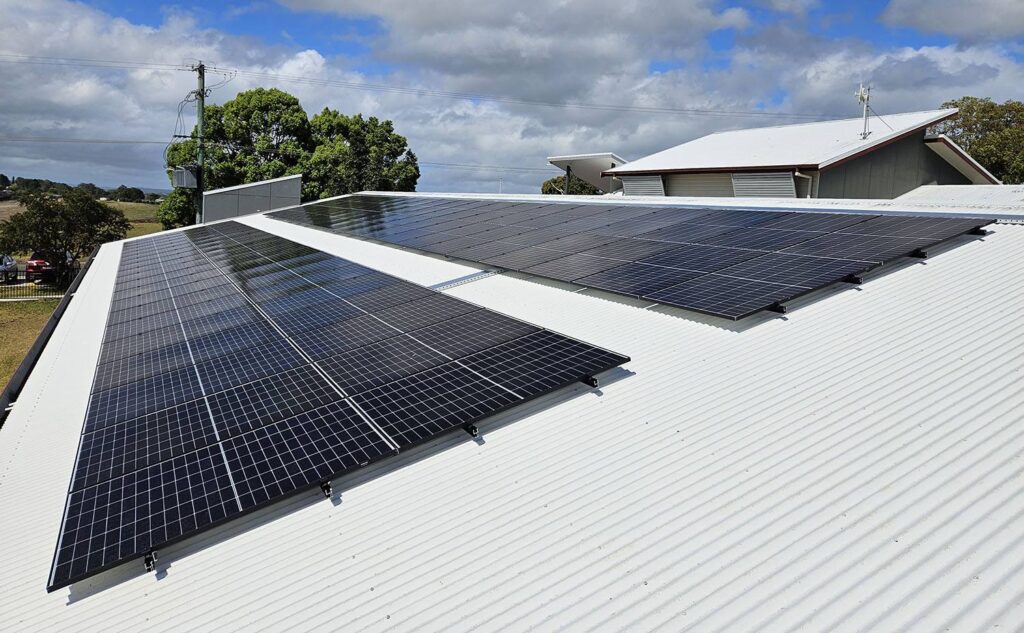
System size means the total panel capacity in kW. As an example from the government, 19 panels of 350 W make 6.65 kW. The inverter is often smaller than the panel total, for instance a 6.6 kW array with a 5 kW inverter, because panels rarely reach full output. The panels and inverter have to match the inverter maker’s limits for the system to qualify for the federal rebate.
The government says 1 kW of panels typically makes 3.5 to 5 kWh a day averaged over a year in Australia, depending on location, slope and direction, more in summer and less in winter. See solar on cloudy and rainy days.
You send 1 or 2 recent bills for a free energy assessment. We size solar and battery from your real consumption. If you already have solar, we check whether it covers the day and whether a battery or extra panels is the right move. See how to read your power bill, battery sizing and adding more panels to an existing system.
Want a quick steer on battery size first? The 60-second which home battery is right for me quiz works from your solar, power bill and backup needs and suggests a likely size range in real module steps.
Getting an electric car? Add it to the sizing with the solar to charge my EV calculator.
Live in Byron Bay, Tweed Heads, Kingscliff or Lismore? We install there too, with our own team, working from our workshop near Mullumbimby.
It depends on your daily use, roof and goals. As a rough example only, 19 panels of 350 W make 6.65 kW. We size from your bills.
Not always. The government notes a bigger system costs more upfront and takes longer to pay for itself, and the best value comes from using as much solar as you can on site.
How much would it cost for your home? See a typical price range in about a minute with our free solar and battery price calculator.
Panels can go on different roof faces or other structures, and a battery makes better use of a smaller array.
Yes, tell us your plans so we can design in headroom.
Last checked 7 October 2026. Only the manufacturer’s, the network’s or the government’s own documents are used; app menus and defaults change between models and versions, so if your screen looks different, call us rather than guess.
Adding an electric car to the sums? The EV buyer’s guide shows each car’s consumption and how much extra solar a typical day’s driving needs.
Planning to move hot water onto solar as well? The hot water heat pump buyer’s guide and sizing calculator shows the tank size and daily energy for your household and how a heat pump fits inside a solar system’s midday output.
Planning to leave gas as well? Induction cooking adds roughly 0.5 to 2 kWh a day and a heat pump 2 to 5; the getting off gas guide explains how that changes the solar and battery size.
Sizing for a house that does not exist yet? The new build solar and battery planner works from the appliance list instead of a bill, with the BASIX notes for the Northern Rivers.
Air conditioning changes the answer more than any other appliance: see the air conditioning on solar and a battery calculator.
A pool pump or pool heat pump is pure daytime load: the running your pool on solar guide and calculator shows how many kW of panels it wants and how to time it.
Switching to all-electric soon? Our full home electrification guide shows how much solar a heat pump, induction cooking and an EV typically add.
Start with the free tools (no details needed to see a result): solar and battery price calculator, is my solar battery-ready? checker or the 60-second battery quiz.
See all the free calculatorsBook a free 15-minute chat
The chat is with our head electrician, about your power bills and what you want from a system. No obligation and no sales script; the firm price comes after we have seen your bills and your home.
See it on a real job: 6.65 kW solar and a 9 kWh Sigenergy battery in Mullumbimby and 20.9 kW Jinko solar and a Sigenergy battery in the Lismore area.

Sun Connect Solar: local solar and battery installers based near Mullumbimby, serving the Northern Rivers NSW. SAA-accredited installer. NSW electrical contractor licence 343044C. Our own electricians, no subcontractors.
Accredited and approved:




© 2026 Sun Connect Solar.