
How do you charge an electric car from solar and a home battery?
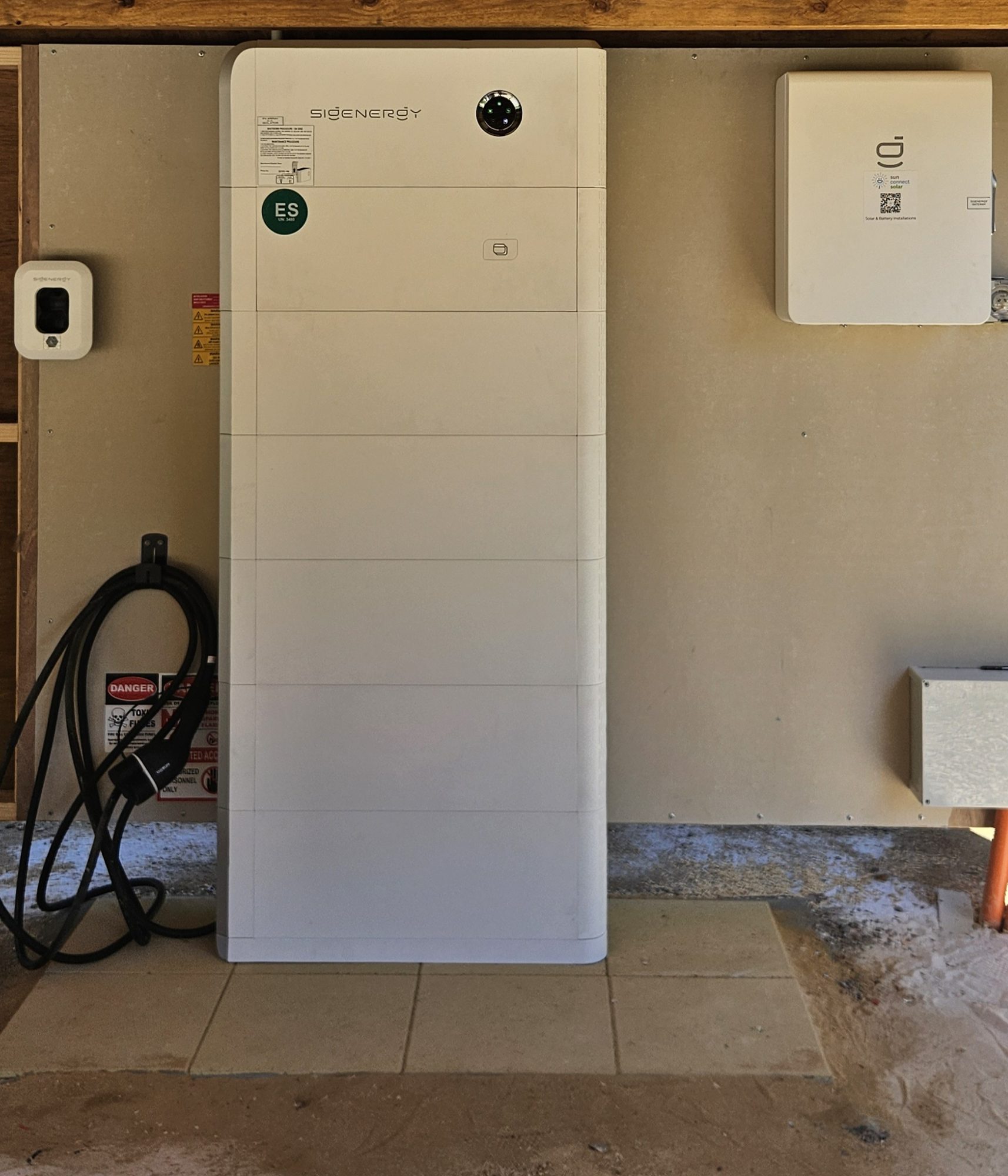
A solar-aware EV charger can top up your car with spare solar instead of exporting it for a small credit, and it can charge from your home battery or from cheap off-peak power when the sun is not out. We install EV chargers for homes with and without solar. Here is how the modes work, using Sigenergy’s published charger information.
Get my free energy assessment →
We’ll text you within minutes. Or call 0483 903 020.
The charging modes
- Surplus solar charging: the charger uses solar left over after the house has taken its share. Sigenergy says its AC charger charges with surplus solar and lets you set a priority between the charger and home loads.
- Battery boost: the home battery adds energy to speed up charging, with a cut-off charge level you set so you do not drain the house.
- Scheduled charging: for example solar-surplus charging in the middle of the day and cheap off-peak charging overnight, if your electricity plan has an off-peak rate. See time-of-use and feed-in tariffs.
- Fast charging: the Sigen EV AC Charger is listed at up to 22 kW, but what you actually get is limited by your home supply and the car’s onboard charger.
AC or DC charger?
Sigenergy’s AC charger is a wall unit with an IP65 rating, designed to work with a SigenStor battery. Its DC option, SigenStor EV DC, is a 25 kW unit that connects on the DC side so an EV can be charged directly from solar and the battery. Sigenergy lists vehicle-to-home and vehicle-to-grid as capabilities, limited by what the EV itself supports, so check your car. See home EV charger installation and our Huonbrook DC charger case study.
What to plan before you buy a charger
- Your switchboard: an EV charger is a big new load, and an older board may need upgrading. See switchboard upgrades and RCBOs.
- Single or three-phase supply: it changes how fast you can charge. See single-phase vs three-phase.
- Blackout backup: some owners leave the EV charger off the backup circuits so it cannot flatten the battery. See charging an EV in a blackout.
- Your driving: the more you charge in the middle of the day, the more solar you use. Most solar only helps if the car is home in daylight.
Businesses: commercial EV chargers.
Why locals choose us
- Our own in-house team designs every system and does every install. 25 years in solar and large commercial electrical work. No subcontractors.
- A face-to-face site visit before every install: compliant battery position, switchboard and RCBO check, no surprises on the day.
- SAA-accredited installer and Sigenergy-approved, with a 25-year workmanship warranty on our installation work.
Questions we get asked
Can I charge my EV for free from solar?
You can charge from your own solar instead of buying grid power, but the panels and charger have to be paid for, and the car needs to be home in daylight. We do not promise savings.
Do I need a battery to charge from solar?
No. A solar-aware charger can use surplus solar alone. A battery adds the option of charging in the evening from stored solar.
Can I install an EV charger without solar?
Yes. We install chargers for homes with and without solar.
Can my EV power my house?
Some EVs and chargers support vehicle-to-home. Sigenergy lists it for its DC charger, limited by what your car supports, so check your model before relying on it.
How fast will my car charge?
It depends on the charger, your home supply and the car. A charger rating is a ceiling, not a promise.
Sources
Last checked 7 October 2026. Only the manufacturer’s, the network’s or the government’s own documents are used; app menus and defaults change between models and versions, so if your screen looks different, call us rather than guess.
- Sigenergy Australia: Sigen EV AC Charger
- Sigenergy Australia: SigenStor EV DC (25 kW EV-Home Energy Bridge)
- Sigenergy’s official SigenStor Home User Manual, Single-phase (Version 04): backup networking, Gateway, installation position, operating temperature, working modes